
Beyond the Classroom: Why Hands-On Self-Defence Training Matters
Discover why guided practice, feedback and varied training partners matter in self-defence. Explore MINDSET's classes and workshops in Adelaide.
Learning about personal safety is important. Understanding awareness, avoidance, de-escalation and self-defence principles helps us consider how to respond to potentially threatening situations.
However, understanding a physical technique and being able to perform it are two different things.
At MINDSET Self-Defence & Close Quarters Combat, we believe practical training should combine clear explanations with supervised participation, constructive feedback and opportunities to practise.
Our teaching approach has developed through years of self-defence instruction, with longstanding roots in New Zealand and training now offered in Adelaide, South Australia.
Understanding a Technique Is Only the Beginning
Watching a demonstration or reading an explanation can help someone understand how a technique is intended to work.
But practical movement involves timing, coordination, balance, positioning and decision-making. These elements can be difficult to appreciate through observation alone.
Supervised practice gives participants opportunities to become familiar with movements, recognise difficulties and make adjustments.
A 2021 systematic review of motor-skill learning in school physical education found that feedback was useful for developing motor skills in that setting. Although these findings are not a guarantee of real-world self-defence performance, they support the value of thoughtful instruction and constructive feedback.
This is one reason why MINDSET places practical participation at the centre of its training approach.
What Happens During Practical Self-Defence Training?
Our training combines several complementary activities.
Open discussions and demonstrations
We discuss realistic personal-safety situations, explore different responses and explain why particular actions may be appropriate.
Awareness, avoidance, boundary-setting and de-escalation are important parts of these discussions.
Hands-on practical drills
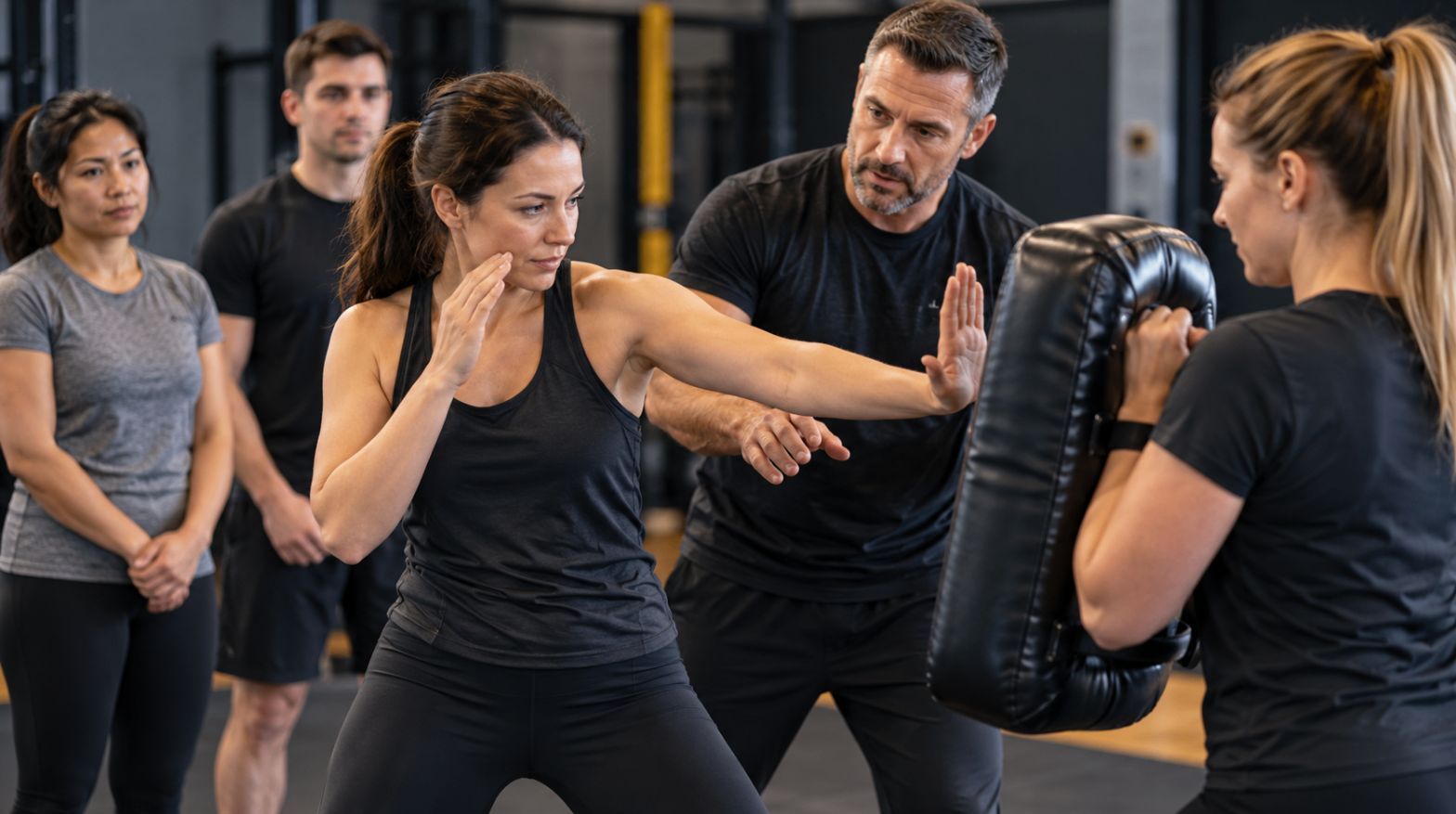
Participants practise selected movements in a supervised environment, allowing them to explore positioning, coordination and movement.
Activities are adapted to the experience and capabilities of participants.
Instructor feedback
Instructors observe participants and provide practical guidance.
Small adjustments in posture, movement or positioning can help learners understand a technique more clearly.
Controlled scenario practice
Where appropriate, participants practise decision-making and physical responses in carefully managed scenarios.
The objective is to develop familiarity with different situations, not to create unnecessary risk or encourage confrontation.
Why Training With Different Partners Matters
People vary considerably in height, weight, strength, movement and physical ability.
A technique practised with one cooperative partner may feel very different when working with someone of another size or build.
Practising with different partners can help participants:
- Recognise how distance and positioning affect movement.
- Adapt to different heights, body types and physical capabilities.
- Understand the limitations of particular techniques.
- Become more comfortable working with unfamiliar training partners.
- Develop greater awareness of the importance of flexibility and decision-making.
These activities must be appropriately supervised and conducted within each participant's abilities and comfort level.
At MINDSET, the aim is not to prove who is stronger. It is to develop understanding through constructive, practical experience.
Developing Confidence Through Realistic Training
Confidence can be an important benefit of participating in self-defence training, but it must be based on realistic expectations.
No training programme can eliminate every risk or guarantee a successful outcome in a confrontation.
Practical training can, however, provide opportunities to explore responses, develop physical skills and better understand personal capabilities and limitations.
We emphasise recognising possible dangers early, maintaining personal boundaries, avoiding unnecessary confrontation and creating opportunities to move towards safety.
Physical self-defence techniques are one part of that wider personal-safety approach.
Practical Self-Defence Training in Adelaide
MINDSET offers several training options for people interested in developing practical personal-safety skills.
Women's Self-Defence Classes
Our Saturday women's self-defence classes in Adelaide provide an opportunity to practise practical skills in a supportive group environment.
Explore Women's Self-Defence Classes
Personal One-on-One Training
Private training allows participants to focus on their personal goals, abilities and learning requirements with individual instruction.
One-on-one training is available by arrangement from Monday to Saturday.
Explore Personal Self-Defence Training
Group Training and Self-Defence Workshops
MINDSET also offers group training and practical workshops, including specialist women's self-defence workshops.
Training arrangements and workshop availability depend on the particular programme or event.
Explore Our Classes, Courses and Workshops
View Workshop Registration Opportunities
Learning Through Practice
Self-defence training is not about memorising movements or believing that one technique will work in every situation.
It involves understanding personal safety, exploring available options, developing physical skills and continuing to learn through guided experience.
At MINDSET, we believe meaningful instruction combines knowledge, participation, feedback and realistic expectations.
Interested in practical self-defence training in Adelaide?
Contact MINDSET to Discuss Your Training Options